

Research agenda
Advancing theory and spatial thinking to better understand social–ecological systems, promote land system sustainability, and improve human well-being. Our work is quantitative and spatially explicit. We combine satellite Earth observation, geospatial data science, spatial statistics, land-system modelling, and deep learning, and we work from local to global scales.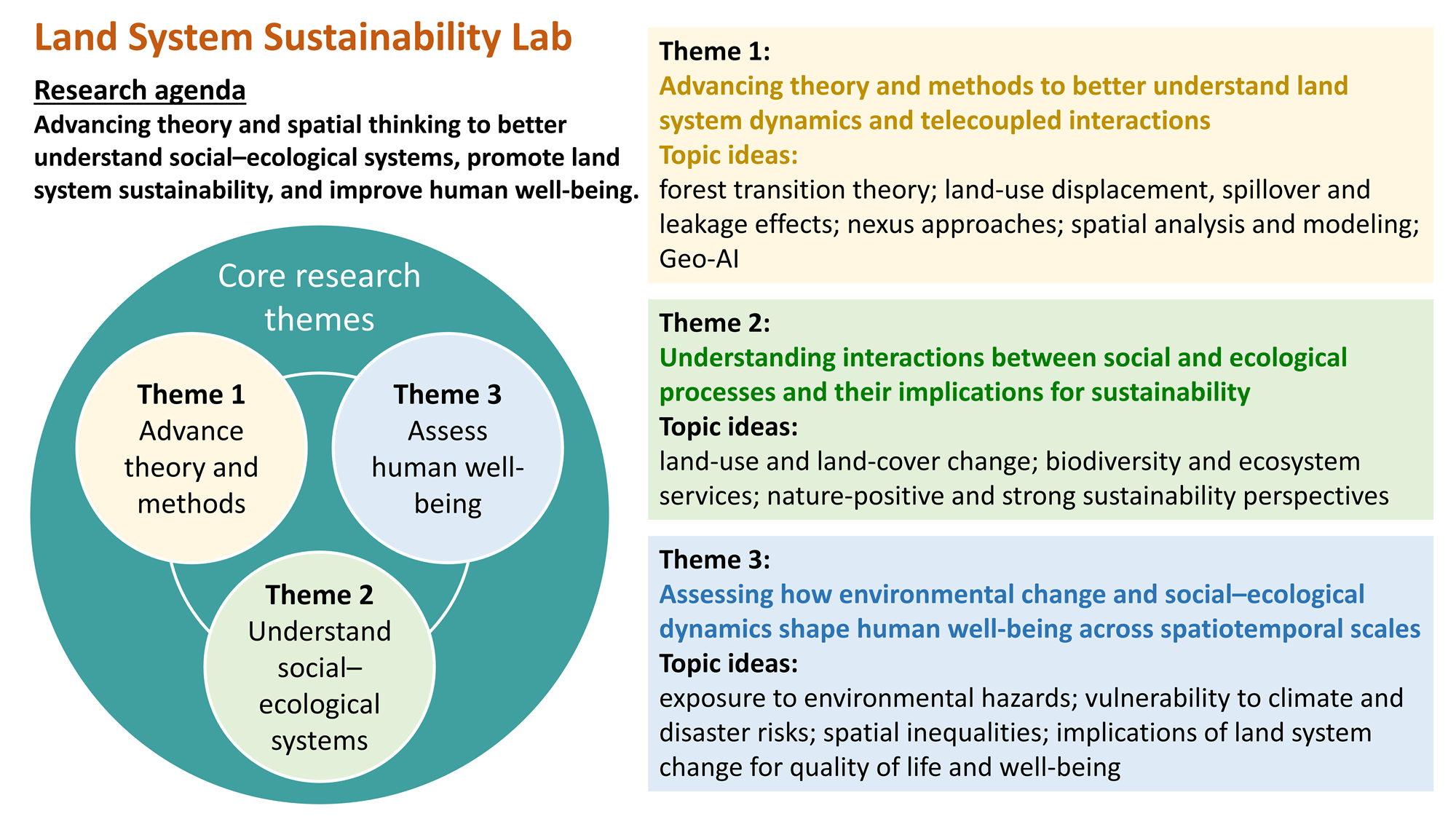
The lab's research agenda and three core research themes.
Core research themes
The three themes share methods and data, and they overlap deliberately: the theory and methods developed under Theme 1 support the social–ecological analysis in Theme 2, which in turn underpins the well-being assessments in Theme 3.Theme 1 · Advance theory and methods
Land system dynamics and telecoupled interactions — forest transition theory, land-use
displacement, nexus approaches, and Geo-AI.
Theme 2 · Understand social–ecological systems
Interactions between social and ecological processes, and what they mean for sustainability.
Theme 3 · Assess human well-being
How environmental change and social–ecological dynamics shape human well-being across
spatiotemporal scales.