> ## Documentation Index
> Fetch the complete documentation index at: https://lss-lab.kankyo.tohoku.ac.jp/llms.txt
> Use this file to discover all available pages before exploring further.
# Land System Sustainability Lab
> Estoque Lab — Department of Frontier Sciences for Advanced Environment, Graduate School of Environmental Studies, Tohoku University
We are a group of land-system scientists and remote-sensing researchers at Tohoku University.
We study how land is used and how it changes — and what those changes mean for biodiversity,
ecosystem services, and human wellbeing.
## What we do
Our research agenda is **advancing theory and spatial thinking to better understand social–ecological
systems, promote land system sustainability, and improve human well-being.**
Land use is where people and nature meet. It drives biodiversity loss and carbon emissions, and it
is also one of the largest levers we have for addressing them. We treat land as a
**social–ecological system**: a system in which human decisions and ecological processes shape each
other across space and time.
Our work is quantitative and spatially explicit. We combine satellite Earth observation, geospatial
data science, spatial statistics, land-system modelling, and deep learning, and we work from local
to global scales.
Three questions run through everything we do:
* **How and why do land systems change?**
* **Who is affected — and how are biodiversity, ecosystem services, and wellbeing impacted?**
* **Which strategies can reconcile conservation, climate adaptation, and other land uses?**
## Research themes
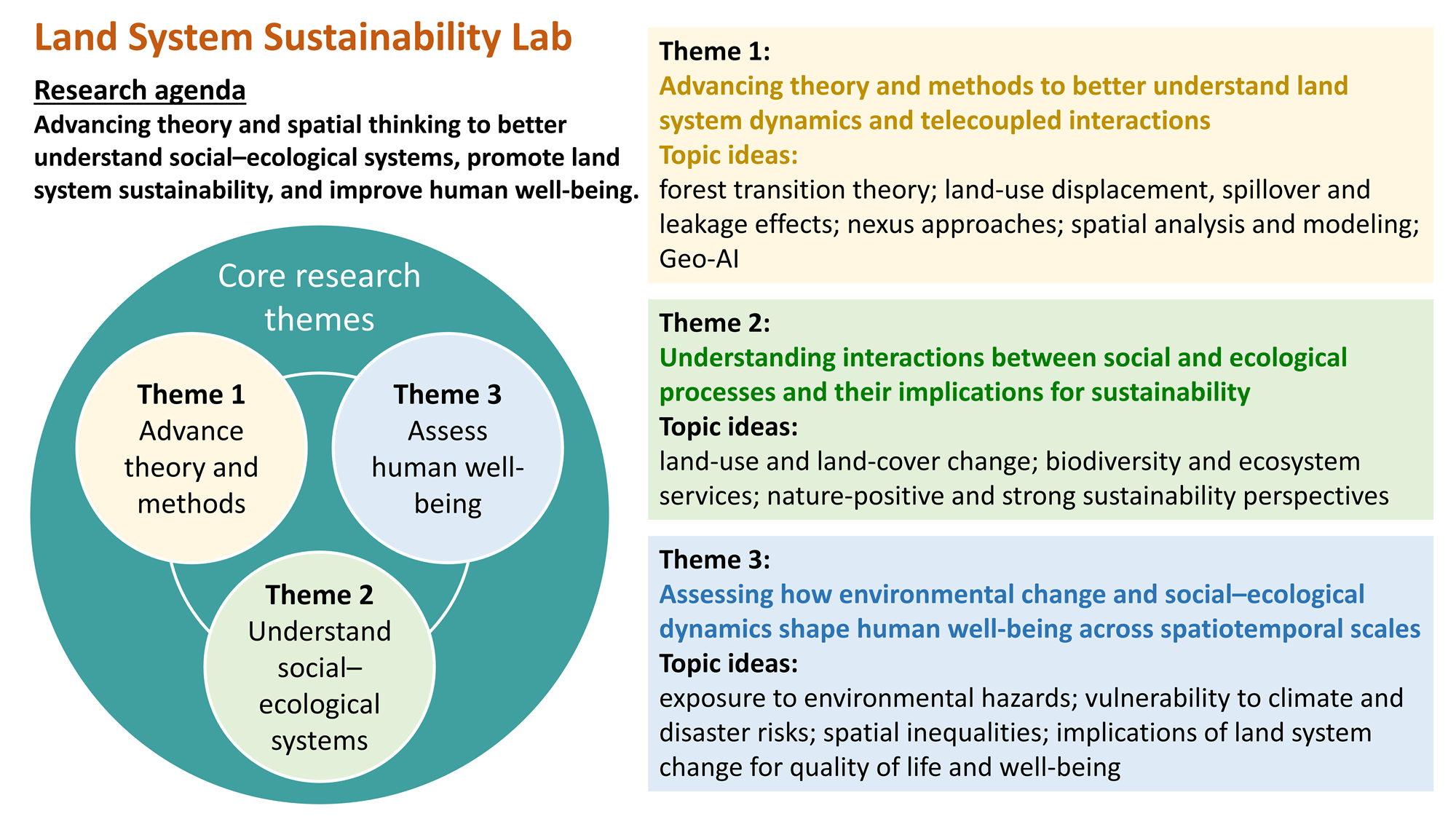 Land system dynamics and telecoupled interactions — forest transition theory, land-use
displacement, nexus approaches, and Geo-AI.
Interactions between social and ecological processes, and what they mean for sustainability.
How environmental change and social–ecological dynamics shape human well-being across
spatiotemporal scales.
## Recent news
* **26–27 August 2026** — Asst. Prof. Ahmed Derdouri participates in the [International Symposium on Integrated
Use of Projected Population Mesh Data in Japan](/en/news#27-august-2026) at FRIS, Tohoku University,
Sendai.
* **3–7 August 2026** — Assoc. Prof. Ronald C. Estoque participates in the [Fourth Lead Author Meeting of the
IPCC Special Report on Climate Change and Cities](/en/news#7-august-2026) in Bhopal, India.
* **4 August 2026** — Asst. Prof. Ahmed Derdouri presents "Simulating Japan's Land-Use Futures with a Scalable
Agent-Based Modelling Framework" at [The 1st Climate Change Adaptation Research Meeting](/en/news#4-august-2026)
at the University of Tokyo.
[All news →](/en/news)
## Where we are
We are based on the **Aobayama campus** of Tohoku University in Sendai, Japan, in the Graduate
School of Environmental Studies.
Faculty, researchers, and staff.
Opportunities for prospective students and collaborators.
Land system dynamics and telecoupled interactions — forest transition theory, land-use
displacement, nexus approaches, and Geo-AI.
Interactions between social and ecological processes, and what they mean for sustainability.
How environmental change and social–ecological dynamics shape human well-being across
spatiotemporal scales.
## Recent news
* **26–27 August 2026** — Asst. Prof. Ahmed Derdouri participates in the [International Symposium on Integrated
Use of Projected Population Mesh Data in Japan](/en/news#27-august-2026) at FRIS, Tohoku University,
Sendai.
* **3–7 August 2026** — Assoc. Prof. Ronald C. Estoque participates in the [Fourth Lead Author Meeting of the
IPCC Special Report on Climate Change and Cities](/en/news#7-august-2026) in Bhopal, India.
* **4 August 2026** — Asst. Prof. Ahmed Derdouri presents "Simulating Japan's Land-Use Futures with a Scalable
Agent-Based Modelling Framework" at [The 1st Climate Change Adaptation Research Meeting](/en/news#4-august-2026)
at the University of Tokyo.
[All news →](/en/news)
## Where we are
We are based on the **Aobayama campus** of Tohoku University in Sendai, Japan, in the Graduate
School of Environmental Studies.
Faculty, researchers, and staff.
Opportunities for prospective students and collaborators.